

Table of Contents
- Why Online Shirt Sizing Goes Wrong (and How to Fix It)
- How to Measure T-Shirt Size at Home in 5 Steps
- T-Shirt Size Chart for Men and Women: How to Read It Right
- Understanding Fit Types: Slim, Classic, and Relaxed
- How to Choose Custom T-Shirt Size for Your Group
-
Common Sizing Mistakes to Avoid
- Mistake 1: Trusting the Letter Size You Wear Elsewhere
- Mistake 2: Ignoring Shrinkage on Pure Cotton
- Mistake 3: Measuring Over Bulky Clothing
- Mistake 4: Mixing Up Body Measurements and Garment Measurements
- Mistake 5: Assuming Everyone in a Group Knows Their Size
- Mistake 6: Skipping the Chart Because "You Know Your Size"
- Frequently Asked Questions
Last Updated: September 16, 2026
Why Online Shirt Sizing Goes Wrong (and How to Fix It)
Ordering the wrong shirt size online is the most common frustration in online apparel shopping, and it rarely happens because you measured badly, it happens because the size chart you trusted was built for a different body. Learning how to choose correct shirt size online comes down to two things: vanity sizing and shrinkage.
The Vanity Sizing Problem
Vanity sizing means labeling garments with smaller numbers than their actual measurements to flatter the buyer. A shirt tagged "Medium" today can measure several inches wider than a Medium from a decade ago, so a Medium from one brand is not a Medium from another. Treat the tag as a starting point, never a guarantee.
Fabric Shrinkage: What to Expect After Washing
Natural cotton fibers relax and tighten when exposed to heat, so most 100% cotton shirts lose a small amount of length and width after the first few washes. Blends with polyester or spandex hold their shape noticeably better.
How to Measure T-Shirt Size at Home in 5 Steps
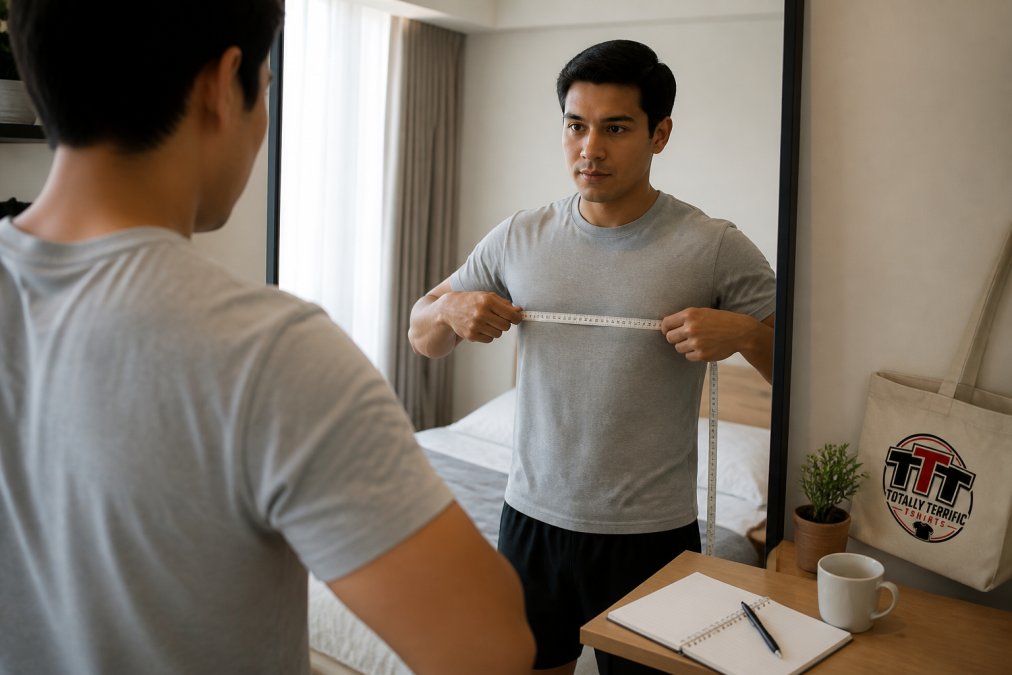
Learning how to measure t-shirt size at home takes about five minutes and one soft tape measure. Capture your true body measurements, then compare them to the garment's chart, not to a letter from another store.
What You'll Need Before You Start
- A flexible cloth tape measure, not a metal carpenter's tape
- A mirror, or a friend for the back and shoulder measurements
- A plain, fitted t-shirt to wear while measuring
- A pen and paper to record each number
Step-by-Step Measurement Guide
- Chest circumference: Wrap the tape around the fullest part of the chest, keeping it level under the arms. Keep the tape snug but not tight, and breathe normally.
- Waist measurement: Measure around your natural waistline, roughly at the belly button, without pulling the tape tight.
- Shoulder width: Measure from the edge of one shoulder to the edge of the other, across the back.
- Sleeve length: Start at the shoulder seam and measure down to where you want the sleeve to end.
- Torso length: Measure from the high point of the shoulder straight down to your preferred hem.
Write every number down, rounding to the nearest half inch for simplicity and accuracy.
T-Shirt Size Chart for Men and Women: How to Read It Right
A t-shirt size chart for men and women lists body measurements, garment measurements, or both, and the difference between those columns is where most shoppers get tripped up. Read the labels carefully before matching your numbers.
Body Measurements vs. Garment Measurements
Body measurements describe your actual body. Garment measurements describe the flat-laid shirt, usually measured across the chest.
International Size Conversion Basics
Sizing labels are not standardized across borders. A European "L" often runs closer to a US "M," and Asian sizing typically runs smaller still.
| Region Label | Typical US Equivalent | Watch For |
|---|---|---|
| US S/M/L | Same | Vanity sizing between brands |
| EU 48-50 | US M | Runs one size smaller |
| UK 38-40 | US M | Similar to EU |
| Asian L | US S/M | Runs notably smaller |
Understanding Fit Types: Slim, Classic, and Relaxed
Fit type changes how a shirt feels even when measurements match, and it's the most overlooked variable in online shirt shopping. Slim fit tapers through the waist and chest; classic fit offers a standard, straight cut with room to move; relaxed fit adds extra room through the body and sleeves.
Why the Same Letter Size Fits Differently Across Cuts
A size chart tells you the body the shirt was drafted for, not the finished garment. Two shirts both tagged Large can differ by two to three inches across the chest once you account for the cut, a slim Large might measure 21 inches flat while a relaxed Large from the same brand measures 24.
How to Check a Brand's Garment Measurements Before You Buy
This is the step most shoppers skip, and it's the fastest way to stop guessing:
- Find the garment measurement column. Many brands list a flat chest width, body length, and sleeve length for each size, trust those numbers over the letter.
- Measure a shirt you already love. Lay your best-fitting tee flat, measure armpit to armpit, and double it. That's your target chest circumference.
- Compare your target to the chart's flat width. If your favorite shirt measures 22 inches flat (44 inches around) and the new brand's Large measures 20 inches flat (40 inches around), you need their XL, even though you "wear a Large."
- Check the shoulder and length too. Chest width gets all the attention, but shoulder seam placement and body length are what make a shirt look intentional versus borrowed.
Matching Fit to Body Shape and How You'll Wear It
Your body shape and fit preference matter more than the label. Broader shoulders or a longer torso sit better in a classic or relaxed cut, since slim cuts pull at the chest and ride up when you raise your arms. Layering or wearing untucked? Relaxed gives you the drape. Want a clean silhouette? Slim or classic does the work.
A quick way to decide:
| If you... | Lean toward | Because |
|---|---|---|
| Have broad shoulders or a longer torso | Classic or relaxed | Slim pulls and rides up |
| Want a tailored, close look | Slim | Tapers through waist and chest |
| Plan to layer or wear untucked | Relaxed | Extra room drapes cleanly |
| Are between sizes and unsure | Classic, sized up | Forgives shrinkage and fit drift |
How to Choose Custom T-Shirt Size for Your Group
Group orders need one extra step: collect everyone's measurements before you place the order. Guessing leads to exchanges, and exchanges on custom-printed apparel are rarely possible. Build a shared form asking each person for chest, waist, and preferred fit, for a team of nurses, a church group, or a family reunion, that five-minute ask saves weeks of back-and-forth.
A quick reference for common group needs:
| Group Type | Best Approach | Why |
|---|---|---|
| Small friend group | Collect sizes individually | Avoids exchanges |
| Sports or work team | Standardize on classic fit | Consistent look |
| Family reunion | Offer two fit options | Covers varied body shapes |
| Faith or community group | Confirm design, then size | One print run |
Common Sizing Mistakes to Avoid
Most wrong-size orders trace back to a handful of repeatable mistakes. Knowing the mechanism behind each turns a guess into a right-first-time order.
Mistake 1: Trusting the Letter Size You Wear Elsewhere
Because of vanity sizing, a Medium in one brand can measure several inches wider than a Medium in another. The letter is a marketing label, not a measurement. Always compare your body numbers, or your flat chest width from a shirt you love, against that brand's chart.
Mistake 2: Ignoring Shrinkage on Pure Cotton
A 100% cotton shirt can lose a small amount of length and width after the first few hot washes and dryer cycles. Blends with polyester or spandex hold their shape better. If you're between sizes and the shirt is pure cotton, size up. If it's a blend and you prefer a closer fit, stay with your measured size.
Mistake 3: Measuring Over Bulky Clothing
Measuring over a hoodie or thick sweatshirt inflates every number and can push you a full size off. Measure over a fitted tee, or bare skin, and keep the tape snug but not tight. Breathe normally.
Mistake 4: Mixing Up Body Measurements and Garment Measurements
A chart listing a 20-inch chest width is giving you a flat, garment measurement, double it to compare against your full chest circumference. Confusing the two is the most common cause of a wrong-size order, and the easiest to fix.
Mistake 5: Assuming Everyone in a Group Knows Their Size
Most people guess their size, and most guesses are wrong. For custom-printed apparel, exchanges are often not possible, so collect chest, waist, and fit preference from each person before you order, a five-minute form beats a weeks-long back-and-forth.
Mistake 6: Skipping the Chart Because "You Know Your Size"
This is how most returns happen. Two minutes with a tape measure and a brand's chart beats a two-week exchange.
Frequently Asked Questions
How do I know my shirt size without a measuring tape?
Grab a shirt from your closet that fits you well and lay it flat. Use a ruler, a piece of string, or even a phone charging cable to measure the chest from armpit to armpit, then double that number. Compare it to the size chart on the website. If you're between sizes, size up for a relaxed fit or size down for a tailored fit. This method works because you're measuring a garment you already know fits.
Should I size up or down for online t-shirt orders?
Size up if you prefer a relaxed fit, plan to tumble dry on high heat, or are between sizes on the chart. Size down if you want a slim or tailored fit and the fabric is pre-shrunk. Cotton shirts can shrink up to 5% after the first few washes, so factoring in shrinkage matters. When in doubt, check the brand's specific size chart because fit varies widely between manufacturers.
Do different brands have different shirt sizing?
Yes, sizing varies significantly between brands. A medium from one company might match a large from another. This happens because there's no universal standard for apparel sizing in the United States. Always check the specific brand's size chart before ordering, and look for customer reviews that mention fit. If you're ordering custom shirts for a group, request a sample or size up for safety.
How can I tell if a shirt will shrink after washing?
Check the fabric content and care label. 100% cotton shirts shrink the most, typically 3-5% in length and width after the first wash. Blends with polyester or pre-shrunk cotton shrink less. Wash in cold water and tumble dry on low to minimize shrinkage. If the listing mentions 'pre-shrunk' or 'compacted cotton,' expect minimal change. When ordering custom shirts, ask about shrinkage expectations.