

Table of Contents
- Is Faith-Based Fashion Worth It for Daily Wear? The Honest Answer
- What Faith-Based Fashion Really Means (Beyond the Hype)
- A Practical Daily-Wear Evaluation Framework
- How to Style Graphic Tees for Daily Wear
- Preventing Fading on Funny Graphic Tees and Faith Tees
- Where Faith-Based Apparel Works: Workplace, School, and Social Settings
- The Downsides Nobody Mentions: Modesty, Messaging, and Trade-Offs
- Conclusion: Is Faith-Based Fashion Worth It for You?
- Frequently Asked Questions
Last Updated: October 6, 2026
Is Faith-Based Fashion Worth It for Daily Wear? The Honest Answer
Here's the tension most articles skip: a shirt only works as a wearable reminder if you reach for it on a Tuesday, not just at a conference.
Federal Trade Commission guidance on textile labeling and care requires apparel to carry accurate fiber content and care instructions, which is exactly the information you should check before buying.
Below, we break down comfort, cost per wear, styling, and the trade-offs nobody mentions.
What Faith-Based Fashion Really Means (Beyond the Hype)
Faith-based fashion is apparel that carries a spiritual message through words, symbols, or imagery, worn as part of ordinary life rather than reserved for services and events. Christian clothing sits inside that broader category, alongside faith-based apparel from other traditions.
The category has grown past the church-aisle stereotype. Modern designs range from a single small cross to full scripture references, and the best ones function as conversation starters rather than billboards.
Subtle Designs vs. Bold Designs: Which Fits Your Wardrobe?
Subtle designs work best when you want the shirt to blend into an existing wardrobe and start conversations only when someone looks closely.
A practical rule: if you would wear it to a school event or a family gathering without a second thought, it is subtle enough. If you would save it for a specific crowd, it is bold.
Why People Wear Christian Clothing Every Day
People wear Christian clothing daily for three reasons that come up again and again: it acts as a spiritual reminder to the wearer, it signals identity to others, and it opens conversations that a plain tee never would. The reminder effect is the underrated one. A faith message you see in the mirror each morning does more work than one you see once a month.
A Practical Daily-Wear Evaluation Framework
Most articles tell you faith-based apparel is "comfortable" and "versatile" and stop there. That is not a framework, it is a vibe. Here is the one we actually use, built around five checks that predict whether a shirt survives a real week: fabric weight, print method, fit accuracy, washability, and message durability. If a garment fails two or more, it belongs in the event drawer, not the daily rotation.
| Check | What Good Looks Like | What to Avoid | Why It Matters |
|---|---|---|---|
| Fabric weight | Roughly 4.3-5.3 oz/yd² for a standard tee; heavier for cooler months | Tissue-thin fabric that goes sheer in sunlight | Light fabric pills and loses shape fast |
| Fabric type | Ring-spun cotton or a cotton/poly blend | Rough open-end cotton with a scratchy hand | Ring-spun feels softer and drapes better |
| Print method | Screen print for bold graphics; DTG for detailed or low-volume designs | Thin, patchy ink coverage with visible shirt texture through it | Print method drives how long the design lasts |
| Fit | Published half-chest and body-length measurements | Only S/M/L with no numbers | Numbers prevent returns and bad drape |
| Care | Machine washable with similar colors | Hand-wash-only or dry-clean-only | If it does not fit your routine, you will not wear it |
| Message | Still true to you in six months | Trendy phrasing you will tire of | Prevents closet waste |
Comfort, Fit, and Fabric: What to Check Before You Buy
Fabric weight is the number most shoppers ignore and the one that matters most. Ring-spun cotton has a smoother, softer hand than standard open-end cotton because the fibers are combed and twisted tighter, which also helps it resist pilling.
Fit is where online buying goes wrong most often. Check the half-chest measurement, not the size letter, and compare it to a shirt you already like.
Print Durability: The Test That Separates Keepers From Closet Clutter
Print method is the single biggest predictor of whether a design survives a year of washing. Direct-to-garment (DTG) printing bonds ink into the fabric and shines on detailed or full-color artwork, but it can fade faster with hot water and high dryer heat.
A simple at-home check before you commit to a brand: look at the print edges in the product photo. Clean, dense edges usually signal a better print. Fuzzy or see-through edges usually signal a print that will crack.
Cost Per Wear: The Math That Settles the Debate
Cost per wear is total price divided by the number of times you actually wear the item. A shirt worn twice a week for a year gets roughly 100 wears.
Run the math honestly. If a garment lasts through a full year of regular rotation, the per-wear figure drops fast. If it fades or shrinks in a month, the "cheaper" option was never cheaper.
Inclusivity and Fit: The Gap Most Brands Still Have
Not every faith-based brand sizes past a certain point, and inclusive sizing is still inconsistent across the category. Before you buy, check three things: the size range (does it go past 3XL?), and whether the brand publishes real measurements rather than just letters. A shirt that fits one person beautifully can gap or cling on another, and that is a sizing-chart problem, not a you problem.
How to Style Graphic Tees for Daily Wear
Style graphic tees for daily wear by treating them as a base layer, not the whole outfit: tuck or half-tuck into jeans, layer under an open button-down or denim jacket, and keep the rest of the look quiet so the message reads clearly.
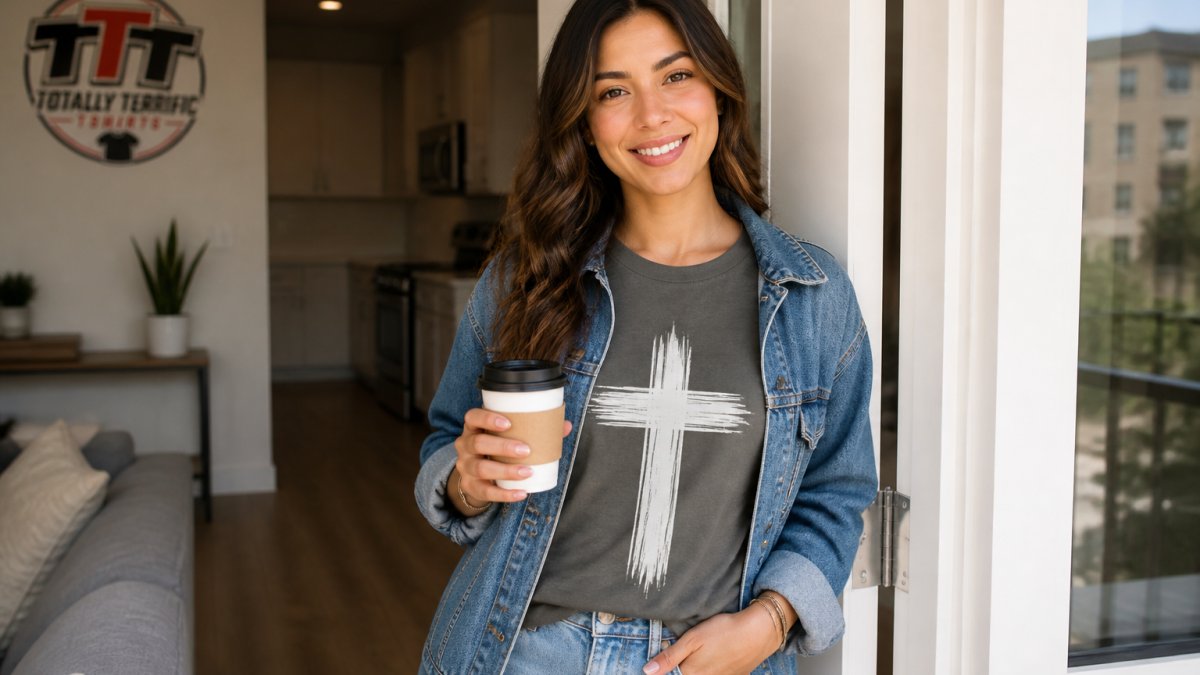
Three combinations that work almost anywhere:
- Graphic tee plus straight-leg jeans and clean sneakers
- Graphic tee under an open flannel or denim jacket with chinos
- Graphic tee tucked into a midi skirt with a simple cardigan
Keep accessories minimal. The shirt is doing the talking.
God's Favorite Child - Holy Spirit Activate →
Preventing Fading on Funny Graphic Tees and Faith Tees
Preventing fading on funny graphic tees and faith tees comes down to three habits: wash inside out in cold water, skip the dryer or use low heat, and never iron directly on the print. Heat and abrasion are what kill a design.
A few specifics that make a real difference:
- Turn the shirt inside out before it goes in the machine
- Wash with similar colors, not with heavy denim or towels
- Tumble dry low or hang dry
- Store folded, away from direct sunlight
Where Faith-Based Apparel Works: Workplace, School, and Social Settings
Faith-based apparel works in most casual settings and needs judgment in formal or regulated ones. Casual workplaces, school events, gyms, and social gatherings are generally fine.
The practical test is whether the message could be read as directed at someone else. A shirt that states your own belief reads differently from one that argues a point.
The Downsides Nobody Mentions: Modesty, Messaging, and Trade-Offs
Faith-based fashion has real trade-offs, and pretending otherwise does the category no favors. A balanced answer to "is it worth it" has to name them. Here are the five that come up most, plus how to handle each.
Messaging Is One-Directional
Once you wear it, you do not control how it lands. A bold design can invite debate you did not plan for, and a stranger may read a statement as directed at them rather than as your own belief. The practical fix is to choose designs that state your faith rather than argue a point.
Modesty Standards Vary Widely
A design that fits one congregation may feel off in another. Necklines, sleeve length, and fit all carry different weight in different communities. If modesty matters to you, look for brands that show the shirt on real bodies and list the actual measurements, so you can judge coverage before it arrives.
Dress Codes and Setting Judgment
Faith-based apparel works in most casual settings and needs judgment in formal or regulated ones. Casual workplaces, school events, gyms, and social gatherings are generally fine. Client-facing roles, uniformed environments, and formal occasions call for something quieter. The practical test is whether the message could be read as directed at someone else. When in doubt, choose the subtle design and let the conversation come to you.
Print Durability and Styling Limits
Print quality varies enormously across the category, which is why the wash test matters more than the product photo. A design that cracks or fades in a month turns a faith statement into a chore. Styling is also narrower than a plain tee: a bold graphic anchors the whole outfit, so you have less room to layer patterns or loud colors around it.
The Performative-Branding Risk
This is the one nobody wants to say out loud. Wearing a faith message can slide from expression into performance if the shirt becomes a substitute for the behavior it points to. The honest check is simple: would you wear this shirt on a day no one would see you? If yes, it is expression. If no, it might be branding.
Ethical and Transparent Production
A brand's values should extend past its messaging. Before you buy, look for published material details, care instructions, and any information about where and how the apparel is made. Transparency about sourcing and labor is a reasonable thing to expect from a company selling values-driven clothing. If a brand is loud about its message and silent about its production, that gap is worth noticing.
Conclusion: Is Faith-Based Fashion Worth It for You?
The real challenge with faith-based apparel is not finding a design you like, it is finding one that survives your actual week.
At Totally Terrific Tshirts, we build our Christian tees as a canvas for self-expression and storytelling, with designs made to spark meaningful conversations.
Get started with Totally Terrific Tshirts and find a shirt you will actually reach for on a Tuesday. Browse the full collection at totallyterrifictshirts.com.
Frequently Asked Questions
What is faith-based fashion, and is it only for church?
Faith-based fashion is clothing designed to express Christian values, scripture, or spiritual identity through words and imagery. It is not limited to church settings. Many people wear faith-based apparel as everyday wear, pairing a graphic tee with jeans, joggers, or a jacket for work, errands, or social outings. The key is choosing designs and fits that match your daily routine, not just Sunday mornings.
How can you tell if a faith-based clothing brand is high quality?
Check the fabric content first. Solid-color tees made from 100% ring-spun cotton tend to feel softer and hold their shape better than basic cotton blends. Look for details like a seamless double-needle collar, a tear-away label, and a tubular fit that reduces twisting after washing. Also review care instructions: brands that recommend washing with similar colors and tumble drying low are usually upfront about how their garments hold up over time.
Is it appropriate to wear faith-based apparel in professional settings?
It depends on your workplace dress code. A subtle design, like a small scripture reference or a clean typographic message, usually works in business-casual environments. Bold graphics with large imagery may be better saved for casual Fridays or off-hours. If your workplace leans formal, try layering a faith tee under a blazer or cardigan so the message shows only when you want it to.
How do you keep faith-based and funny graphic tees from fading?
Wash them inside out in cold water with similar colors, and avoid heavy detergent or fabric softener, which can break down print material over time. Tumble dry on low or hang dry to protect both the print and the fabric. Storing shirts in a cool, dry place away from direct sunlight also helps maintain color. These steps apply whether the design is a bold faith message or a funny graphic tee.