

Table of Contents
- 1. Build a Nursing School Study Schedule Template That Actually Works
- 2. The Best Nursing School Supplies for Clinicals (What You Actually Need)
- 3. Nursing Student Burnout Prevention: Protect Your Mental Resilience Early
- 4. Financial Survival: Budgeting Through Nursing School Without Drowning
- 5. Navigating Toxic Clinical Environments and Difficult Instructors
- 6. Your Tech Stack: Apps and Digital Tools That Keep You Organized
- 7. From Pre-Reqs to Core Nursing: Making the Transition Without Falling Apart
- Conclusion
- Frequently Asked Questions
Last Updated: September 25, 2026
1. Build a Nursing School Study Schedule Template That Actually Works
Nursing school survival starts with one unglamorous truth: the students who make it through aren't the smartest ones, they're the ones with a system for nursing school survival. This guide from Totally Terrific Tshirts pulls together beginner-friendly tips that actually move the needle, from your first semester to your last clinical rotation.
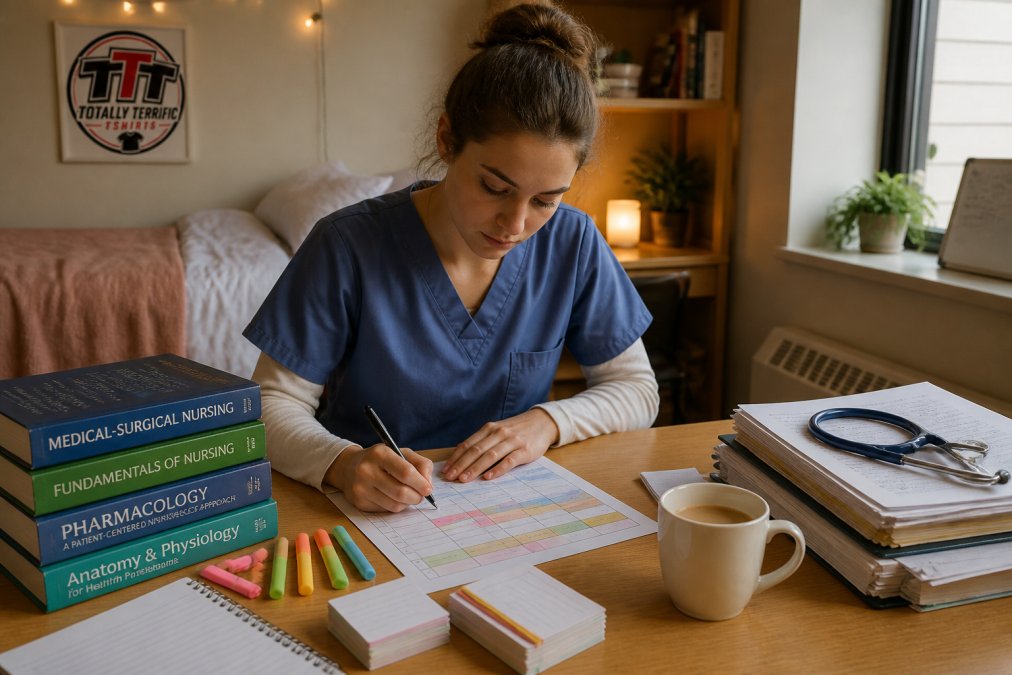
Here's a simple starting structure:
- Monday and Wednesday: lecture notes review, 45 minutes per class
- Tuesday and Thursday: clinical prep and skills practice
- Friday: light review or rest
- Weekend: two longer blocks for pharmacology and pathophysiology
How to Map Your Semester Around Exams and Clinicals
Print your syllabus, then mark every exam, paper, and clinical shift on one calendar. Work backward two weeks from each exam and block review time there first. Everything else fills the gaps.
A concrete example for a peak week:
- Sunday: 3-hour pharmacology block (new material)
- Monday: 1-hour pathophys review + 1-hour practice questions
- Tuesday: clinical shift (no studying after)
- Wednesday: 2-hour exam prep for Friday's test
- Thursday: 1-hour light review + 30-minute self-quiz
- Friday: exam, then rest
- Saturday: 2-hour catch-up block
Active Recall and Spaced Repetition: The Two Habits That Save Your GPA
Reading notes feels productive. It isn't. Active recall means closing the book and writing down what you remember, then checking what you missed. Spaced repetition means reviewing that material again on days one, three, and seven.
- Read the chapter once, actively.
- Close the book and write everything you remember on a blank page.
- Check your page against the chapter and mark gaps in red.
- Turn each gap into a flashcard.
- Review those flashcards on day 1, day 3, and day 7.
| Habit | How It Works | Best Used For |
|---|---|---|
| Active recall | Close notes, write from memory | Pharmacology, pathophys |
| Spaced repetition | Review on days 1, 3, 7 | Long-term retention |
| Study groups | Quiz each other out loud | Clinical reasoning |
| Practice questions | NCLEX-style drills | Exam strategies |
The Study Group Rule That Actually Works
Most study groups fail because they turn into social hour. The fix: every session, each person brings three questions they got wrong that week. You work them out loud together and leave when they're done. No questions, no meeting.
2. The Best Nursing School Supplies for Clinicals (What You Actually Need)
The best nursing school supplies for clinicals fit in one bag and get used every shift. Everything else stays home.
Clinical bag essentials:
- A quality stethoscope you can hear through
- Bandage scissors and a penlight
- A small notebook for vitals and notes
- Hand sanitizer, granola bars, and a water bottle
- Comfortable shoes you can stand in for 12 hours
Clinical Bag Essentials vs. Stuff You'll Never Touch
Students overpack in the first semester and underpack by the third. Buy less, replace what wears out, and keep your bag light enough to carry across a whole shift.
3. Nursing Student Burnout Prevention: Protect Your Mental Resilience Early
Nursing student burnout prevention begins before you feel exhausted, not after. Burnout builds slowly through skipped meals, lost sleep, and the belief that rest is optional.
Warning Signs You're Headed for Burnout
Watch for early signals: dreading clinicals you used to enjoy, snapping at classmates, skipping meals, lying awake replaying the day. Catching two or three early gives you room to adjust.
4. Financial Survival: Budgeting Through Nursing School Without Drowning
Money stress is the topic most guides skip, and it's the one that ends careers. Budgeting through nursing school means knowing your monthly numbers before the semester starts, and knowing the hidden costs nobody warns you about.
The Hidden Costs of Nursing School
Tuition is the number everyone plans for. It's rarely the number that breaks students. The costs that surprise beginners tend to fall into a few predictable buckets:
- Clinical supplies: stethoscope, scrubs, shoes, badge, penlight, bandage scissors, and a second set of scrubs for when the first gets soiled. These add up fast in the first month.
- Exam and licensure fees: NCLEX registration, background checks, drug screens, fingerprinting, and state board application fees. These hit in your final semester, often all at once.
- Clinical travel: many programs place students at sites an hour or more from campus. Gas, parking, and sometimes tolls become a weekly line item.
- Uniform and equipment replacements: shoes wear out, scrubs tear, stethoscopes get lost. Budget for one replacement per semester.
- Health requirements: titers, physicals, vaccines, and CPR certification renewals are usually the student's responsibility.
- Technology: a reliable laptop, a clinical app subscription, and sometimes a required testing platform fee.
A Three-Column Budget That Works
Start with three columns: fixed costs (rent, insurance, phone), variable costs (food, gas, supplies), and a small buffer for clinical uniforms and exam fees. Track spending for one month, then cut one category, not five.
...on the eighth day God created Nurses →
A simple monthly structure:
| Column | What Goes In | Target Share |
|---|---|---|
| Fixed | Rent, insurance, phone, subscriptions | Roughly half of income |
| Variable | Food, gas, clinical supplies, parking | Roughly a third of income |
| Buffer | Uniforms, exam fees, replacements, emergencies | Whatever remains |
Working During Nursing School: What's Realistic
Many students work during pre-reqs and try to keep the same hours in core nursing, usually the point where grades slip. Core nursing requires clinical hours that don't flex, and those conflict with most shift work.
The realistic options are usually:
- Per diem or PRN roles in a hospital or clinic, where you pick up shifts around clinicals.
- On-campus jobs like tutoring, lab assistant, or library work, which tend to be more flexible.
- CNA or patient care tech roles, which pay modestly but build clinical skills you'll use later.
Financial Aid, Scholarships, and Aid You Might Be Missing
Beyond federal aid, there are two categories of money nursing students often overlook:
- Program-specific scholarships: many hospitals and health systems offer scholarships in exchange for a work commitment after graduation. These are usually posted on the program's financial aid page or announced by the school of nursing.
- Employer tuition assistance: if you already work in healthcare, your employer may cover part of your tuition. Ask HR directly, this benefit is often underused.
The Mindset Shift That Protects Your GPA
Money stress hurts your focus, not just your wallet, students worried about rent don't retain pharmacology. The fix isn't ignoring money; it's giving it a designated time and place. A weekly 30-minute budget check-in keeps money from leaking into every study session.
5. Navigating Toxic Clinical Environments and Difficult Instructors
Toxic clinical environments exist, and pretending otherwise doesn't help you. What helps is knowing how to respond without burning yourself out or your reputation.
6. Your Tech Stack: Apps and Digital Tools That Keep You Organized
Your tech stack should be small and boring. A calendar app, a note app, a flashcard app, and a shared drive for group projects covers almost everything.
7. From Pre-Reqs to Core Nursing: Making the Transition Without Falling Apart
The jump from pre-reqs to core nursing is the steepest curve in the program. Pre-req courses reward memorization. Core nursing rewards critical thinking, prioritization, and clinical judgment.
Conclusion
Nursing school is hard on purpose, and the students who make it through build systems early and protect their energy. Whether you're celebrating a cohort milestone, gifting a study buddy, or wearing your future profession with pride, our Nurse collection has designs made for exactly that moment, from "...on the eighth day God created Nurses" to "I'm a CNA, What's your superpower." Every shirt is crafted to spark conversations and free shipping kicks in on orders over $75.
Frequently Asked Questions
What is the hardest part of nursing school for beginners?
Most beginners say the volume of material is the hardest part. You're learning pharmacology, pathophysiology, and nursing theory at the same time while preparing for clinical rotations. The fix is a nursing school survival mindset: treat studying like a job, use active recall instead of re-reading, and build a nursing school study schedule template in your first week. That structure keeps you from falling behind when exams stack up.
How many hours a day should a nursing student study?
Plan for two to three hours of focused study per credit hour each week. For a 15-credit semester, that's roughly 30 to 45 hours weekly, including class time. The quality of those hours matters more than the total. Use spaced repetition, practice NCLEX-style questions, and review clinical skills in short sessions. A consistent nursing school study schedule template beats last-minute cramming every time.
What supplies do I really need for my first semester of nursing school?
Start with a quality stethoscope, a reliable watch with a second hand, comfortable shoes for long clinical shifts, a badge reel, and a sturdy tote or backpack. For class, you need a planner, highlighters, and a laptop or tablet for note-taking. Skip the fancy gadgets until you know your program's requirements. The best nursing school supplies for clinicals are the ones you'll actually use every shift.
Is it possible to work while in nursing school?
Yes, but be strategic. Many nursing students work 10 to 20 hours per week, often in flexible roles like PRN patient care tech or tutoring. The key is protecting your study blocks and clinical days. If you're working, nursing student burnout prevention becomes non-negotiable: schedule rest, say no to extra shifts during exam weeks, and lean on study groups. Working is doable when you guard your time.
How do you balance a social life with nursing school?
You don't need to give up your social life, but you do need to schedule it. Block out one or two evenings a week for friends, and protect that time like a class. Join a study group so socializing and studying overlap.