

Table of Contents
- What Is the Tactical Civics Movement? A Beginner's Definition
- Historical Context: From Grand Juries to Constitutional Militias
- The Tactical Civics 11-Week Course: What You'll Learn
- Civic Engagement Strategies for Beginners: Step-by-Step Participation Guide
- Is Tactical Civics Legally Feasible? A Neutral, Fact-Based Analysis
- Glossary of Key Tactical Civics Terms
- Frequently Asked Questions
Last Updated: September 30, 2026
What Is the Tactical Civics Movement? A Beginner's Definition
The tactical civics movement is a grassroots approach to civic engagement built on local organizing, constitutional education, and direct participation in county-level government.

Core Philosophy and Founding Principles
The movement's philosophy centers on the idea that political power flows from the bottom up. Core principles include:
- Local governance first - County officials are more accessible than federal representatives
- Constitutional interpretation - Emphasis on the original text and intent of the Constitution
- Civic education - Structured learning about the rule of law and checks and balances
- Grassroots organizing - Small groups rather than large national campaigns
How Tactical Civics Differs from Traditional Civic Education
Traditional civic education focuses on how government works in theory. The tactical civics movement instead pushes participants toward direct action in their own communities.
Historical Context: From Grand Juries to Constitutional Militias
The movement draws heavily on historical American institutions, particularly the grand jury and the constitutional militia. Legal experts debate how accurately that history is applied, so beginners who know the actual record can tell precedent from rhetoric.
The Role of Grand Juries in the Movement
A grand jury is a group of citizens convened to determine whether there is enough evidence to bring criminal charges. The institution predates the Constitution: colonial grand juries operated under English common law, and the framers mentioned it in the Fifth Amendment, which states that "no person shall be held to answer for a capital, or otherwise infamous crime, unless on a presentment or indictment of a Grand Jury."
- Presentment power, historically, grand jurors could bring forward accusations of misconduct on their own initiative, not only review charges a prosecutor brought to them.
- Local independence, grand jurors were drawn from the community and, in theory, served as a check on overreaching officials.
Constitutional Militia Interpretation
The movement frequently references the constitutional militia, arguing that the Second Amendment's phrase "a well-regulated Militia, being necessary to the security of a free State" refers to all able-bodied citizens rather than organized state forces. That interpretation is contested.
Here is the timeline beginners should know:
- 1788, The Constitution is ratified. Article I, Section 8 gives Congress power to organize, arm, and discipline the militia, and to call it forth to execute federal law and suppress insurrections.
- 1792, The Militia Acts require most free, able-bodied white men of military age to enroll in a state militia and equip themselves. This is the closest the country came to the "citizen militia" model the movement invokes.
- 1903, The Dick Act establishes the organized militia (what became the National Guard) and the unorganized militia as separate categories, shifting the practical role of the militia toward state and federal military forces.
- 2008, In District of Columbia v. Heller, the Supreme Court recognized an individual right to keep and bear arms while also describing the militia as a body that would be "drawn from the people" and "governed by the states." The opinion left the exact scope of militia powers open.
Why This History Matters for Beginners
The movement's credibility with newcomers rests on how well it handles this history. A group that reads the Fifth Amendment, the Militia Acts, and Heller side by side comes away with a nuanced view; one that quotes the Second Amendment without mentioning the 1903 reorganization or modern grand jury rules is presenting a partial picture.
The Tactical Civics 11-Week Course: What You'll Learn
The tactical civics 11-week course is the movement's primary educational offering, structured as a small-group study series. Each week covers a different topic, building from foundational civics toward practical organizing. Most groups meet weekly for about 90 minutes.
Typical topics include:
- The Constitution and its amendments
- The role of grand juries
- County-level government structure
- The legislative process and public policy
- Constitutional interpretation and the rule of law
- Government transparency and accountability
- Grassroots organizing basics
- Civic duty and community engagement
- Checks and balances in practice
- Local governance strategies
- Putting it all together: a personal action plan
How to Find or Start a Group
The movement has no single official directory, so try this:
- Ask at your county party office. Both major parties maintain lists of local civic and study groups.
- Check your library's bulletin board. Libraries frequently host or list civic discussion groups.
- Search community forums and neighborhood apps. Nextdoor, local Facebook groups, and city subreddits often have posts from people seeking study partners.
- Start your own. Six to twelve people is a workable size. Pick a consistent night, rotate the discussion leader, and assign reading a week ahead.
How to Vet a Group Before You Commit
Before joining any study group, ask the facilitator three questions:
- What is the reading list? A balanced civics curriculum includes primary sources, the Constitution, the Federalist Papers, actual court opinions, not just one organization's workbook.
- Does the material present competing viewpoints? If every session reaches the same conclusion, you are in a political meeting, not a study group.
- Who funds the group? Legitimate educational groups are transparent about funding and leadership. If nobody will say who pays for the materials, that is a red flag.
A Note on Cost and Commitment
Most study groups are free or ask participants to cover printing their own materials. Be cautious of any group requiring a significant upfront payment, a signed commitment, or personal financial information before you have attended a single meeting.
What You Should Be Able to Do After 11 Weeks
- Explain the three branches of government and how checks and balances work
- Read a county commission agenda and identify items affecting your neighborhood
- Deliver a two-minute public comment at a local meeting
- Cite a primary source when someone makes a constitutional claim
- Tell the difference between a legal argument and a political one
If you are looking for a warm, welcoming way to start conversations about civics in your own community, our patriotic, teacher-friendly, and "We the People" designs are made for exactly that, and our Christian, Jewish, senior, retired, nurse, country music lover, and funny fun t-shirts give every neighbor a reason to say hello. Explore the collection at totallyterrifictshirts.com.
Ask me about Tactical Civics with QR →

Civic Engagement Strategies for Beginners: Step-by-Step Participation Guide
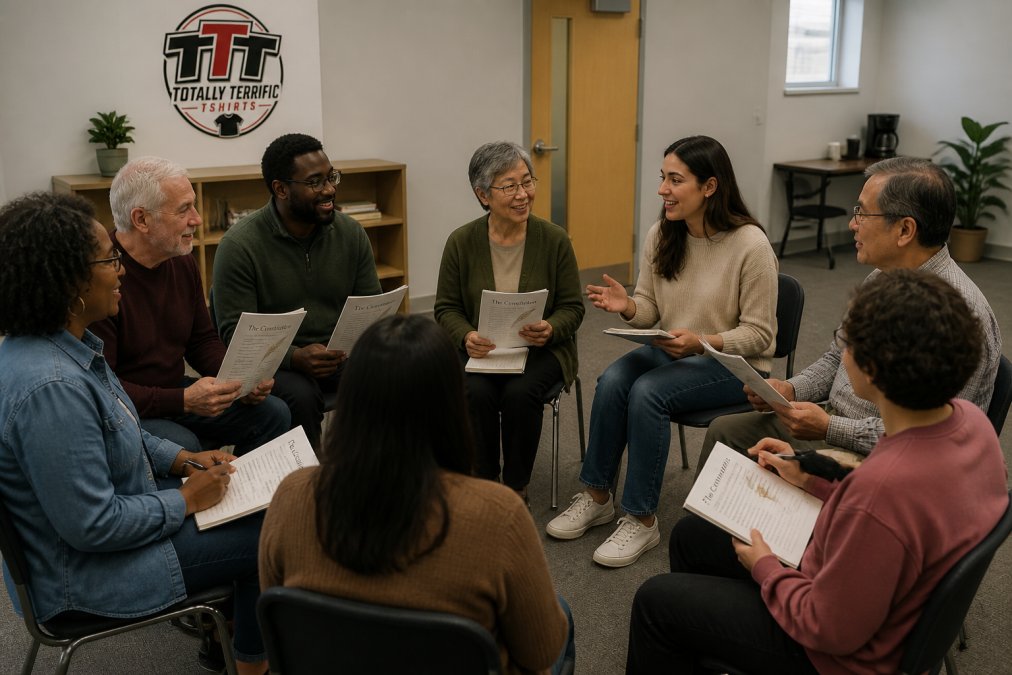
Getting involved starts with a simple sequence:
- Read the founding documents. Start with the Constitution and the Bill of Rights.
- Attend a local meeting. County commission or school board meetings are open to the public.
- Find or form a small group. Six to twelve people is a workable size for discussion.
- Follow the 11-week course. Work through one topic per week.
- Track local decisions. Note how elected officials vote on issues that affect your community.
- Ask questions publicly. Most meetings allow public comment.
- Stay within the law. Peaceful, lawful participation is the foundation of civic engagement.
Starting at the County Level
County government handles more of daily life than most people realize: roads, courts, elections, and public health. The movement's core argument is that this is where one person's voice carries the most weight.
Small Group Educational Series
A small group educational series works best with a consistent schedule and a rotating discussion leader. Keep sessions to about 90 minutes and assign reading in advance.
Is Tactical Civics Legally Feasible? A Neutral, Fact-Based Analysis
Most of what the movement proposes is legal: attending meetings, forming study groups, and petitioning officials are protected activities. Legal questions arise around claims involving grand juries and militia powers.
Here is a plain breakdown:
| Movement Claim | Legal Reality | Practical Takeaway |
|---|---|---|
| Citizens can convene their own grand juries | Grand juries are convened by courts | Join jury service; don't self-convene |
| The militia includes all citizens | Courts interpret militia scope narrowly | Study the rulings before citing |
| County officials can nullify federal law | Federal supremacy limits this | Focus on local policy, not nullification |
| Public comment is a right at meetings | Many states guarantee it; rules vary | Check your local rules first |
Presidential Term Limits and Amendments
The 22nd Amendment limits the presidency to two elected terms. The movement sometimes discusses amendments as a tool for political reform, a legitimate part of the democratic process, though amending the Constitution requires a two-thirds vote in Congress and ratification by three-fourths of the states.
Criticisms and Political Perspectives
Critics argue the movement oversimplifies constitutional law and sometimes promotes interpretations courts have rejected. Supporters counter that civic engagement is healthy regardless of the legal debates. A beginner-friendly approach is to separate the movement's civic education goals from its more contested legal claims.
Glossary of Key Tactical Civics Terms
- Civic engagement: Participation in public life, from voting to attending meetings.
- Grand jury: A citizen panel that reviews evidence for potential criminal charges.
- Constitutional militia: A contested term referring to citizen defense forces.
- Rule of law: The principle that everyone, including officials, is subject to the law.
- Sovereignty: The authority of a governing body over its territory.
- Checks and balances: The system that lets each branch limit the others.
- Grassroots organizing: Building local support from the community up.
- Civic literacy: Understanding how government works and how to participate.
For more context on how civic participation is defined and studied, see the American Bar Association's civics resources and the National Archives' founding documents collection. The U.S. Courts' explanation of grand jury function clarifies what grand juries actually do.
Frequently Asked Questions
What are the core objectives of the tactical civics movement?
The tactical civics movement focuses on educating citizens about constitutional rights, local governance, and the role of grand juries. Its core objectives include increasing civic literacy, encouraging grassroots organizing at the county level, and promoting accountability among elected officials. Rather than relying on national campaigns, the movement emphasizes local action and understanding the legal framework that governs citizen participation in government.
How does the tactical civics 11-week course work for beginners?
The tactical civics 11-week course is structured as a small group educational series that meets weekly. Each session covers a different topic, from constitutional interpretation to county-level organizing. Beginners start with foundational concepts like checks and balances and the legislative process, then progress to practical skills like how to contact elected officials and participate in local meetings. The format encourages discussion and community building among participants.
How can beginners get involved in local civic movements safely?
Start by attending public meetings like county commission or school board sessions to observe how local governance works. Join or form a small study group focused on civic education. Always stay within the rule of law and respect the democratic process. Connect with established civic engagement strategies for beginners, such as volunteering for nonpartisan voter education efforts, and avoid confrontational tactics that could put you or others at risk.
What is the historical context behind the tactical civics approach?
The tactical civics approach draws on historical American traditions of local self-governance, including the role of grand juries as citizen oversight bodies and the constitutional militia concept. It also references the Progressive Era's push for government transparency and accountability. The movement frames itself as a modern continuation of citizens exercising their constitutional rights to petition, assemble, and participate in public policy decisions at the community level.
Are there specific legislative goals associated with tactical civics?
The movement generally avoids a single national legislative agenda, focusing instead on local and state-level accountability. Some groups advocate for amendments related to term limits or government transparency. Others prioritize county-level resolutions that reaffirm constitutional rights. Because the movement is decentralized, goals vary by community. Beginners should research what their local chapter or study group prioritizes before committing to specific advocacy efforts.
What methods do tactical civics groups use to promote their message?
Groups use small group educational series, county-level organizing, and grassroots movement tactics like petition drives and public comment at local meetings. Many rely on civic education materials, including study guides and the tactical civics 11-week course. Social media and community events also play a role. The emphasis is on civic literacy and peaceful, legal participation in the democratic process rather than protest or confrontation.