

Table of Contents
- The Real Reasons Custom Shirts Cost More Than You Think
-
Factors Affecting Custom Apparel Pricing You Need to Know
- Garment Quality and Material Types
- Design Complexity and Color Count
- Order Volume and Bulk Discounts
- Wholesale vs. Retail Blank Pricing
- Setup Fees and Screen Charges
- Turnaround Time and Rush Fees
- Shipping and Logistics Costs
- Garment Sizing and Extended Sizes
- The Psychology of Perceived Value
- Sustainability and Ethical Sourcing
- Regional Tax and Tariff Implications
- Hidden Costs of DIY vs. Outsourcing
- Finding the Best Custom Apparel for 2026 Without Overpaying
- Custom T-Shirt Printing Methods That Impact Your Price
- Hidden Costs of DIY vs. Outsourcing Your Custom Apparel
- The Psychology of Perceived Value in Custom Shirts
- Finding the Best Custom Apparel for 2026 Without Overpaying
- Why Custom Shirts Cost More: The Bottom Line
- Frequently Asked Questions
Last Updated: September 12, 2026
The Real Reasons Custom Shirts Cost More Than You Think
Custom shirts cost more because you're paying for decorated garments, not blank ones. The gap between a blank tee and a custom one isn't one markup, it's a stack of small ones: fabric weight, ink, thread, setup, and human hands all take a cut before your shirt reaches a box.
Factors Affecting Custom Apparel Pricing You Need to Know
Ask any decorator what moves a quote and they'll name the same handful of levers. Custom pricing is a stack of fixed and variable costs, and only the variable ones scale cleanly with quantity.
Garment Quality and Material Types
Fabric is your first cost driver, and it's the one you feel every wash. A heavier cotton tee or soft tri-blend costs more upfront than a thin basic, because raw material costs rise with weight and fiber quality (cottoninc.com). Cheap shirts betray you: a lightweight blank can pill or lose shape after a few cycles. For everyday wear, a teacher's classroom shirt, a retired grandparent's favorite tee, mid-weight ring-spun cotton hits the sweet spot between comfort and durability.
Design Complexity and Color Count
Every color in your design is a separate pass, screen, and charge. A one-color logo is cheap to produce; a six-color illustration with gradients is not. The jump from one to two colors is the biggest relative leap, since you're doubling screens, ink, and registration time. Thin lines and small text are also harder to reproduce cleanly, so decorators often ask for vector artwork. Simplify without losing meaning, fewer colors, bolder shapes, and you'll often get a better-looking shirt for less.
Order Volume and Bulk Discounts
Volume is the great equalizer. Printers spread fixed costs across every unit, so a bulk order of 50 shirts costs less per unit than an order of five, the biggest lever you control. Fixed costs (screens, setup, digitizing, press calibration) don't change whether you print 5 shirts or 500, so as quantity rises the fixed portion shrinks per unit and the price curve drops, steeply at first, then flattening. Small orders aren't punished out of spite, they simply can't absorb setup costs the way large runs can.
Wholesale vs. Retail Blank Pricing
There's another layer beneath the quote: what the decorator pays for the blank. Large decorators buy at wholesale or contract pricing; smaller shops may pay closer to retail, and that difference shows up in your quote even when the finished shirt looks identical.
Setup Fees and Screen Charges
Setup fees cover the one-time work to prepare your job: burning screens, digitizing embroidery files, calibrating the press. They're charged once per design, not per shirt, which is why reorders are cheaper.
Turnaround Time and Rush Fees
Standard turnaround lets the shop batch jobs and share resources; rush orders break that batching and carry a premium. If your date is flexible, standard turnaround is the budget-friendly choice.
Shipping and Logistics Costs
Shipping has two legs, blanks to the decorator, finished goods to you, and both cost money. Heavier garments, larger orders, and split shipments raise the total, so consolidate to one address and order everything at once.
Garment Sizing and Extended Sizes
Extended sizes use more fabric and more ink or thread, so they cost more to produce, a material reality, not a penalty. Build the upcharge into your per-person budget for a mixed group, and always check the size chart, because a returned shirt is money lost.
The Psychology of Perceived Value
Here's the angle most pricing guides skip: cost and value aren't the same thing. A shirt that tells a story, fits well, and sparks a conversation feels worth more than a generic tee, even when the fabric is identical.
Someone buying a shirt for their nursing crew or faith community isn't shopping for the cheapest cotton, they're buying belonging, identity, and a design that says something. That's why a well-made patriotic shirt or a funny fun tshirt can cost more than a plain blank and still feel like a bargain. The cost is in the materials and labor; the value is in the meaning.
Sustainability and Ethical Sourcing
Regional Tax and Tariff Implications
Hidden Costs of DIY vs. Outsourcing
DIY looks cheaper until you count everything. Home printing means buying blanks, transfer paper or vinyl, ink, and equipment, then absorbing failed attempts nobody budgets for, plus your time. Outsourcing bundles those hidden costs into one transparent price, paying a professional for equipment, expertise, and quality control.
Finding the Best Custom Apparel for 2026 Without Overpaying
The best custom apparel for 2026 balances quality, method, and quantity instead of chasing the lowest quote. Start by picking a garment weight that survives real wear, then match your printing method to your order size and design.
A few moves keep costs honest:
- Order in the largest batch your group can commit to, since volume lowers cost per unit
- Simplify your color count when you can, because fewer colors mean fewer setup fees
- Ask for a full price breakdown so setup, printing, and shipping are itemized
- Confirm turnaround time early, since rush orders add cost and stress
- Check sizing carefully, because a returned shirt is money lost
For groups like nurses, teachers, or a country music crew, matching shirts do double duty as team identity and conversation starters. That's the sweet spot where custom apparel earns its keep.
If you want that value without the guesswork, Totally Terrific Tshirts makes it simple. Our apparel is crafted with intention, designed to spark meaningful conversations and inspire connectivity, and every order over $75 ships free. Explore our nurses, teachers, senior, retired, country music lovers, Jewish, Christian, patriotic, and funny fun tshirts collections, and find a design that says exactly what you mean.
Custom T-Shirt Printing Methods That Impact Your Price
The method you choose changes both the look and the ledger. Custom t-shirt printing methods range from fast and flexible to durable and premium, and each prices differently because each consumes different inputs: screens, ink, thread, cure time, and human handling.
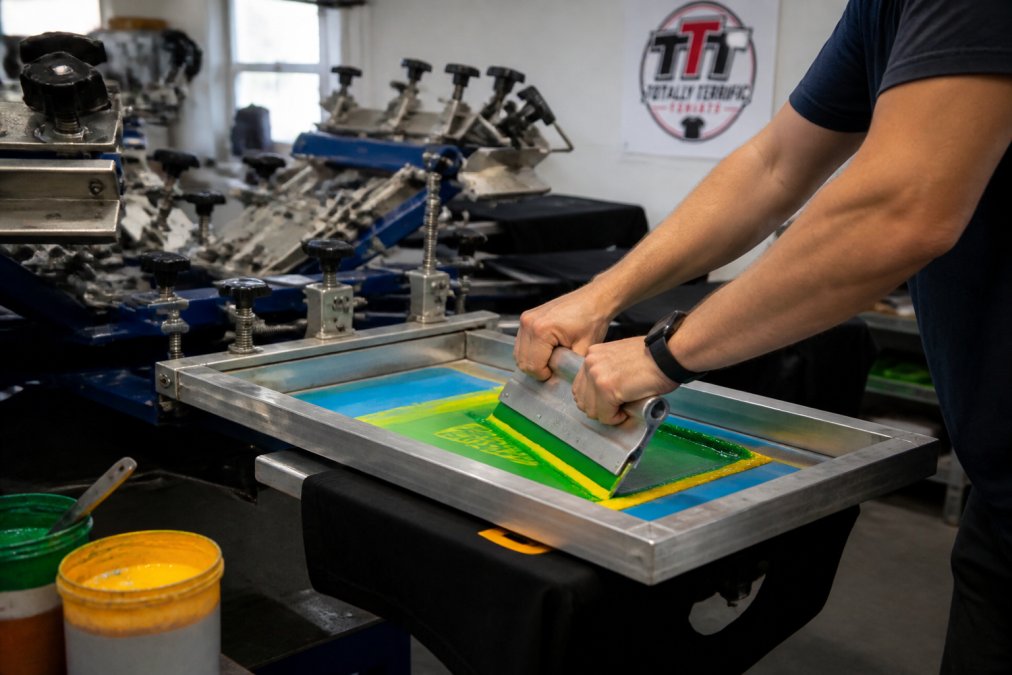
Screen Printing vs. Direct-to-Garment
Screen printing pushes ink through a mesh screen, one screen per color. Each color needs its own screen, ink, and pass through the dryer, which is why setup fees appear upfront, the shop builds a physical stencil for every color before printing a single shirt. Once those screens exist, cost per unit drops fast as quantity climbs. It's the workhorse for team shirts, event runs, and anything with a limited palette.
Direct-to-garment printing works like an inkjet printer for fabric. It skips screens entirely, ideal for small batches and detailed, full-color designs with gradients and photographic elements. The trade-off is a higher cost per unit at scale, since there's no setup to amortize and each shirt takes real machine time. DTG sits best on 100% cotton; heavy blends can affect how the ink cures and lasts (textiles.ncsu.edu).
A quick way to think about it: screen printing rewards volume and simplicity, DTG rewards flexibility and detail. For matching shirts for a nurses crew or teachers team with a bold, simple design, screen printing usually wins on value. For a one-off funny fun tshirt with a detailed illustration, DTG is the natural fit.
| Method | Best For | Setup Fees | Cost Per Unit |
|---|---|---|---|
| Screen printing | Bulk orders, 1-3 colors | Yes, per color | Drops with volume |
| Direct-to-garment | Small batches, full color | No | Steady, higher at scale |
| Embroidery | Polos, logos, durability | Yes, digitizing | Higher, premium feel |
| Print-on-demand | One-off designs | No | Highest per unit |
Embroidery and Specialty Techniques
Embroidery stitches thread into the fabric for a raised, professional finish that survives years of wear. It requires digitizing, a one-time process that converts your logo into a stitch file and carries a setup charge. Stitch count matters: a simple left-chest logo might use a few thousand stitches, while a large back design can run into the tens of thousands. That's why embroidery pricing scales with design size and density, not just quantity.
Specialty finishes like puff ink, metallic, discharge, and water-based inks add cost because they need extra passes, different mesh counts, or careful handling. A common mistake is choosing a specialty technique for a design that doesn't need it. A patriotic shirt with a simple flag graphic doesn't need six specialty passes to look great. Match the method to the garment and message, and you'll save without losing impact. For a retired or senior group ordering comfortable everyday shirts, a clean screen print or soft DTG print often delivers more value than an over-engineered finish.
Turnaround Time and Rush Fees
Time is a pricing lever too. Standard production lets the shop batch jobs, share dryer time, and order blanks efficiently. A rush order breaks that rhythm, jumping the queue, sometimes requiring overnight blank shipping, and often paying staff overtime. That's why rush fees exist, usually as a percentage of the order.
If your event date is flexible, standard turnaround saves money. If it isn't, build the rush cost into your budget from the start.
Shipping and Logistics Costs
Shipping is the quiet line item. Blank apparel ships to the decorator, finished shirts ship to you, and both legs cost money. Heavier garments weigh more, larger orders need bigger boxes, split shipments multiply the cost, and extended sizes take up more carton space.
A practical move: consolidate to one shipping address and order everything at once. For groups like a Christian ministry team or a Jewish community event, one bulk shipment to a single coordinator is almost always cheaper than ten individual drop-ships.
Setup Fees and Screen Charges
Setup fees aren't padding, they cover the labor and materials to prepare your job. Screen printing needs a screen per color, each coated, exposed, and registered; embroidery needs a digitized file; DTG needs a pretreat pass on many fabrics. These are one-time costs per design, which is why reordering is cheaper than the first run.
Garment Sizing and Extended Sizes
Extended sizes cost more to produce because they use more fabric and more ink or thread to cover a larger print area, a real material difference, not a penalty. For a mixed group like a country music lovers fan club, build the extended-size upcharge into your per-person budget so nobody's caught off guard.
Sizing accuracy also protects your budget: a returned or reprinted shirt is money lost, so measure a shirt you already love and compare it to the size chart before ordering. This matters most for senior and retired groups where fit preferences vary widely.
Hidden Costs of DIY vs. Outsourcing Your Custom Apparel
DIY looks cheaper until you count everything. Home printing means buying blanks, transfer paper or vinyl, ink, and equipment, then absorbing failed attempts nobody budgets for, plus your time, since a botched run means starting over.
Outsourcing bundles those hidden costs into one transparent price, paying a professional for equipment, expertise, and quality control. Most people who try DIY beyond a handful of shirts find the savings evaporate fast.
The Psychology of Perceived Value in Custom Shirts
Perceived value explains why two shirts at the same price feel different. A shirt that tells a story, fits well, and sparks a conversation feels worth more than a generic tee, even when the fabric is identical, that's how buyers actually weigh a purchase. Someone buying a shirt for their nursing crew or faith community isn't shopping for the cheapest cotton, they're buying belonging, identity, and a design that says something.
Finding the Best Custom Apparel for 2026 Without Overpaying
The best custom apparel for 2026 balances quality, method, and quantity instead of chasing the lowest quote. Start by picking a garment weight that survives real wear, then match your printing method to your order size and design.
A few moves keep costs honest:
- Order in the largest batch your group can commit to, since volume lowers cost per unit
- Simplify your color count when you can, because fewer colors mean fewer setup fees
- Ask for a full price breakdown so setup, printing, and shipping are itemized
- Confirm turnaround time early, since rush orders add cost and stress
- Check sizing carefully, because a returned shirt is money lost
For groups like nurses, teachers, or a country music crew, matching shirts do double duty as team identity and conversation starters. That's the sweet spot where custom apparel earns its keep.
Why Custom Shirts Cost More: The Bottom Line
Custom shirts cost more because you're buying decoration, durability, and meaning in one garment, not just fabric. The price reflects real labor, real materials, and the setup that turns a blank into something you're proud to wear.
If you want that value without the guesswork, Totally Terrific Tshirts makes it simple. Our apparel is crafted with intention, designed to spark meaningful conversations and inspire connectivity, and every order over $75 ships free. Explore our nurses, teachers, senior, retired, country music lovers, Jewish, Christian, patriotic, and funny fun tshirts collections, and find a design that says exactly what you mean.
Frequently Asked Questions
How much should a custom shirt cost?
Custom shirt pricing depends on several factors, including the printing method, garment quality, design complexity, and order quantity. Bulk orders typically lower the cost per unit. For a specific quote tailored to your design and quantity, visit totallyterrifictshirts.com and explore our custom options.
How does the number of colors in a design affect shirt pricing?
Each additional color in a screen-printed design requires a separate screen and a separate pass through the press, which increases setup fees and labor. Designs with fewer colors cost less to produce. Direct-to-garment printing handles complex, multi-color designs without extra setup, but the cost per unit may be higher for large runs.
Why are high-quality graphic tees more expensive than mass-produced ones?
High-quality graphic tees often use heavier, softer fabrics like tri-blend or ringspun cotton, which cost more per yard. They also involve more durable printing methods, such as screen printing with plastisol inks, and stricter quality control.
Does the type of printing method change the cost of a shirt?
Yes, printing methods significantly impact cost. Screen printing has setup fees but low per-unit costs for bulk orders. Direct-to-garment printing has no setup fees but higher per-unit costs. Embroidery costs more due to digitizing fees and thread work. The best method depends on your design, quantity, and budget.
Custom apparel should feel worth every dollar, and that starts with understanding where your money goes. If you're tired of shirts that fade, pill, or fall flat after a few washes, Totally Terrific Tshirts is built for you. Our designs spark conversations, our apparel is crafted with intention, and free shipping kicks in on orders over $75. Get started with Totally Terrific Tshirts at totallyterrifictshirts.com and wear something that actually means something.