

Table of Contents
- Why Custom Shirts Beat Off-the-Shelf for Tactical Groups
- Durable Fabrics for Tactical Shirts: What Actually Holds Up
- Custom Tactical Shirt Design Ideas for Your Crew
- Bulk Ordering Custom Apparel for Groups: Pricing and Minimums
- Sizing, Fit, and Turnaround: Avoiding the Guesswork
- Compliance, Sustainability, and Group-Specific Design Standards
- Conclusion
- Frequently Asked Questions
Last Updated: September 17, 2026
Why Custom Shirts Beat Off-the-Shelf for Tactical Groups
Custom shirts for tactical enthusiast groups solve a problem generic apparel can't: identity. A team that trains and shows up at the range together deserves gear that says so, and off-the-shelf designs rarely match a unit's name, patch, or sense of humor. At Totally Terrific Tshirts, we've watched crews move from mismatched store-bought tees to coordinated custom apparel, and the difference is immediate.
Durable Fabrics for Tactical Shirts: What Actually Holds Up
Durable fabrics for tactical shirts come down to two things: fiber content and how the shirt is sewn. Get both right and a shirt survives years of range days and wash cycles.
Ring-Spun Cotton vs. Poly Blends
Ring-spun cotton is spun and twisted repeatedly for a softer, stronger yarn. It prints beautifully and feels broken-in from day one, which is why our solid-color shirts use 100% ring-spun cotton. Its weakness: cotton holds sweat against the skin.
Stitching and Construction Details That Matter
The details that separate a shirt that lasts from one that doesn't are invisible from across the room:
- Double-needle collar with high stitch density, so the neckline doesn't ripple after ten washes
- Tubular fit, which minimizes torque and twisting through the body
- Tear-away label, useful if you're rebranding with your own group tag
- Shoulder-to-shoulder taping, which stops seams from pulling apart under a plate carrier or backpack strap
Custom Tactical Shirt Design Ideas for Your Crew
Custom tactical shirt design ideas work best with a simple rule: front for identity, back for the message. A reader should know who you are in one glance and want to ask about it in the next. The difference between sharp on screen and sharp on a shirt comes down to placement zones, file prep, and visibility.
Placement Zones: Where Artwork Actually Belongs
Think of a shirt as a grid with four usable zones, each with a job:
- Left chest (3-4 inches wide): Unit crest, small logo, or a single word. This is the "who we are" zone and it reads at conversation distance.
- Full front (10-12 inches wide): The statement, the QR code, or a large graphic. Keep it centered and at least 2 inches below the collar seam so it doesn't ride up under a strap.
- Full back (11-13 inches wide): The message, the roster, or the event name. This is your billboard, give it room to breathe.
- Sleeve or nape (2-3 inches): A motto, a date, or a small mark. Great for a subtle detail that rewards a closer look.
Artwork Submission: What Your Printer Actually Needs
Before a single shirt is printed, your artwork has to survive a translation from screen to fabric. Here's what makes that smooth:

- Vector files (AI, EPS, SVG) scale cleanly and are ideal for logos and text. Raster files (PNG, JPG) need to be at least 300 DPI at final print size or they'll look soft.
- Transparent backgrounds prevent the dreaded white box around a logo.
- Spot colors vs. full color: If your group has an exact team color, tell your printer the Pantone number so it matches across reorders.
- Fonts: Convert text to outlines, or send the font file, so a missing font doesn't change your design.
QR Codes, Unit Patches, and Front-and-Back Prints
QR codes have become the sleeper feature of group apparel. A shirt like our We the People means YOU with Tactical Civics QR code puts a scannable link on the front and a statement on the back, so a stranger can learn about your group without you saying a word. That's the whole point of a conversation-starting shirt.
- Left chest is the traditional home for a crest or unit mark.
- Right chest is where a name tape or role identifier often goes.
- Center back works for a large patch or a full unit name.
- Sleeves suit small morale patches or a flag.
High-Visibility vs. Low-Visibility Design
Not every group wants to be seen. Some want to stand out at a charity run; others want a subdued look for training day. Decide which camp you're in before picking colors:
- High-visibility: Bright base colors, contrast trim, reflective or IR-reflective ink for low-light events. Great for safety-focused groups, event staff, and public-facing teams.
- Low-visibility: Earth tones, muted grays, and tonal prints where the design is subtle until you're close. Popular with tactical and field-oriented groups who don't want to advertise.
Print Methods: DTG, Sublimation, and Embroidery
Three methods dominate group orders, and each suits a different design:
| Method | Best For | Feel | Detail Limit |
|---|---|---|---|
| DTG | Cotton shirts, full-color art | Soft, sits in the fabric | High detail |
| Sublimation | All-over prints, poly shirts | No hand feel at all | Unlimited colors |
| Embroidery | Logos, patches, polos | Raised, durable | Simple shapes only |
Bulk Ordering Custom Apparel for Groups: Pricing and Minimums
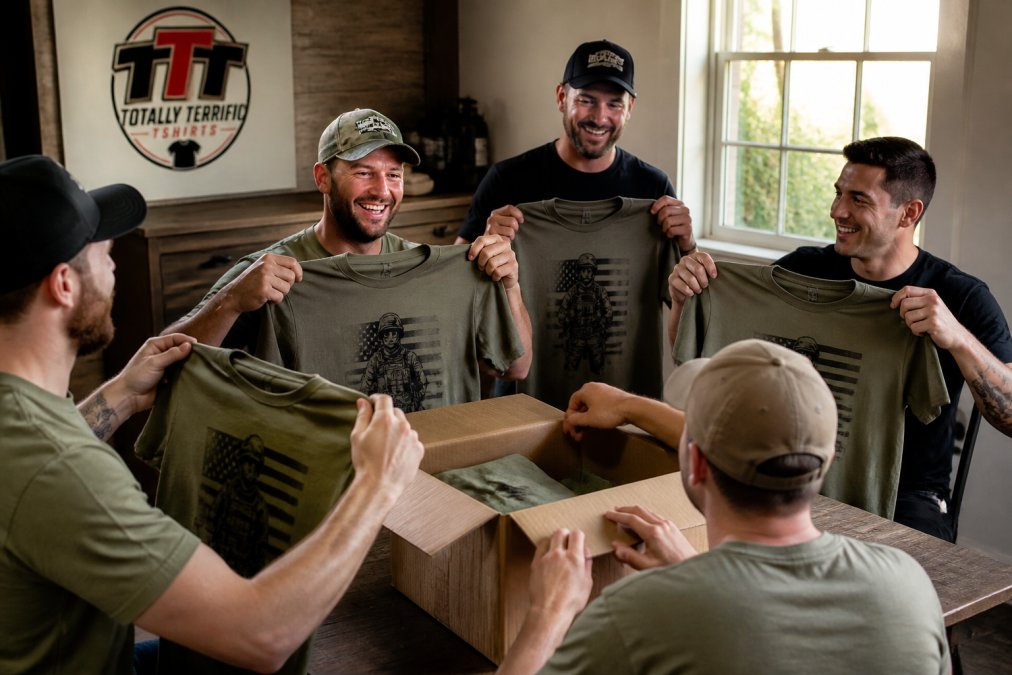
Bulk ordering custom apparel for groups is simpler than most people expect. Small crews worry they'll be forced into a hundred-shirt minimum, and that fear keeps them from ordering at all.
What $34.99 Per Shirt Actually Gets You
Our custom shirts run $34.99 each, covering the shirt plus printing. There's no separate setup fee hiding in the total, and free shipping kicks in on orders over $75, which most group orders clear easily.
What that gets you in practice:
We the People means YOU with Tactical →
- A soft ring-spun cotton shirt built for DTG printing
- Double-needle collar and tubular fit
- Front-and-back print capability on a single garment
- Colors from a broad palette, so your group can match a team color
Sizing, Fit, and Turnaround: Avoiding the Guesswork
Sizing is where online apparel orders go wrong, and it's almost always a measurement problem rather than a manufacturing one. Our size chart lists length, width, and half-chest in inches for S through 3XL, measured flat. A medium has a 20.1-inch half chest, roughly a 40-inch chest circumference when worn.
Compliance, Sustainability, and Group-Specific Design Standards
Compliance, sustainability, and group-specific design are the three angles most group apparel guides skip, and exactly where a thoughtful order separates itself from a rushed one.
Meeting Organizational Uniform Standards
If your group wears shirts on duty, at a sanctioned event, or as part of a uniform, standards may dictate color, patch placement, and visible branding. Specifics vary, so the practical move is always the same: check with your unit, department, or event coordinator before finalizing artwork.
A few patterns show up again and again:
- Color restrictions: Some organizations require a specific base color (often navy, black, or tan) and limit accent colors.
- Patch placement: Traditional placement puts a unit crest on the left chest and a name or role identifier on the right. If your organization follows that convention, design around it rather than fighting it.
- Visible branding: Some groups prohibit large logos or third-party branding on uniform items. A small left-chest mark is usually safe; a full-back billboard may not be.
- Safety markings: Groups that work near traffic or in low light may need high-visibility elements or reflective material.
Fabric Technology: Matching Material to Mission
Most guides stop at "moisture-wicking." The real decision is which fabric technology fits your climate and use:
- 100% ring-spun cotton: Soft, breathable, prints beautifully, and feels broken-in from day one. It holds sweat against the skin, so it's best for moderate activity, cooler weather, and off-duty wear.
- Cotton-poly blends (like a 65/35 heather): Dry faster, resist shrinking, and hold their shape through repeated washes. A strong all-around choice for a group that wears the same shirt through a long day outdoors.
- Performance polyester: Wicks moisture away from the skin, dries quickly, and is the base for sublimated all-over prints. Ideal for high-sweat activity and warm climates.
- Ripstop-style weaves: A grid of reinforcing threads makes the fabric resistant to tearing and ripping. This is the material family behind many purpose-built combat and field shirts, and it's worth asking about if your group trains hard in brush or on rough terrain.
Sustainability: The Practical Levers
Sustainability in group apparel isn't about a single green label, it's about a few concrete choices:
- Fabric choice: Natural fibers like ring-spun cotton and recycled-content blends reduce reliance on virgin synthetic material.
- Print method: Water-based DTG inks are a lower-impact option than some traditional plastisol processes.
- Print on demand: Producing the quantity your group will actually wear avoids the waste of over-ordering and leftover stock.
- Care habits: Washing cold and air-drying extends a shirt's life, which is the most sustainable decision of all, a shirt worn for years beats a shirt replaced every season.
Group-Specific Design: One Method, Many Audiences
Group-specific design matters because the same printing method serves very different communities, only the artwork changes. A nursing community wants a design that reads professional on a hospital floor. A veterans' group wants something that honors service without looking like a costume. A church group wants warmth. A teachers' group wants something that sparks a smile in the hallway.
Conclusion
The hardest part of outfitting a tactical group isn't the design, it's trusting that the shirt will still look right after a season of use. Fabric, stitching, and print method decide that, not the artwork.
Frequently Asked Questions
What materials are best for custom tactical shirts?
For tactical enthusiast groups, 100% ring-spun cotton offers a soft feel and excellent printability for detailed graphics. If your group needs moisture-wicking performance for range days or field use, polyester blends (like 65% polyester, 35% cotton heather options) dry faster and resist shrinking. Look for double-needle collars and high stitch density, both signs of durable construction that survives repeated washing.
How do I choose a design for a tactical enthusiast group?
Start with your group's identity: unit name, motto, or a shared symbol. Front-and-back prints work well for tactical shirts, with a small chest logo and a larger back graphic. QR codes linking to resources or group pages add a functional twist. Keep colors high-contrast so the design reads clearly from a distance, and make sure any text is large enough to be legible on a moving person.
Can I add custom patches or embroidery to tactical shirts?
For t-shirts, DTG (direct-to-garment) printing handles detailed multi-color graphics.
What is the minimum order quantity for custom tactical apparel?
We accommodate small group orders of 5 to 10 shirts without forcing you into large bulk commitments. This matters for friend groups, small teams, or clubs that want matching shirts without overbuying. Always confirm the minimum before designing, and ask whether per-shirt pricing changes at higher quantities so you can plan your budget accurately.