

Table of Contents
- Why Getting Your Measurements Right for T-Shirt Fit
- What You'll Need Before You Start Measuring
- How to Measure Your Neck, Chest, and Shoulders for T-Shirt Fit
- Measuring Sleeve Length, Bicep, and Wrist for a Comfortable Fit
- Waist, Hip, and Shirt Length Measurements for T-Shirt Fit
- Your T-Shirt Size Chart Guide: Turning Measurements into the Right Size
- Custom T-Shirt Sizing Best Practices for Groups and Gifts
- Fabric Shrinkage and Body Posture: What Most Guides Miss
- Frequently Asked Questions
Last Updated: September 27, 2026
Why Getting Your Measurements Right for T-Shirt Fit
Most people guess their size and hope for the best. That's why so many online orders end up in a return pile or a donation bag. Learning how to measure for perfect tshirt fit takes about ten minutes and saves you from that whole mess.
What You'll Need Before You Start Measuring
Gather your tools first. You need a flexible measuring tape, not a stiff metal one from the hardware store. A cloth tape wraps around curves and gives you real numbers.
Here's your checklist:
- Soft measuring tape (at least 60 inches long)
- A mirror, ideally full-length
- A friend for shoulder and sleeve measurements
- A notepad or phone for writing numbers down
- A well-fitting t-shirt you already own
- Light clothing or just a fitted tee
How to Measure Your Neck, Chest, and Shoulders for T-Shirt Fit
These three numbers form the base of every t-shirt size. Get them right and you're most of the way there. Get them wrong and no size chart on earth will save you.
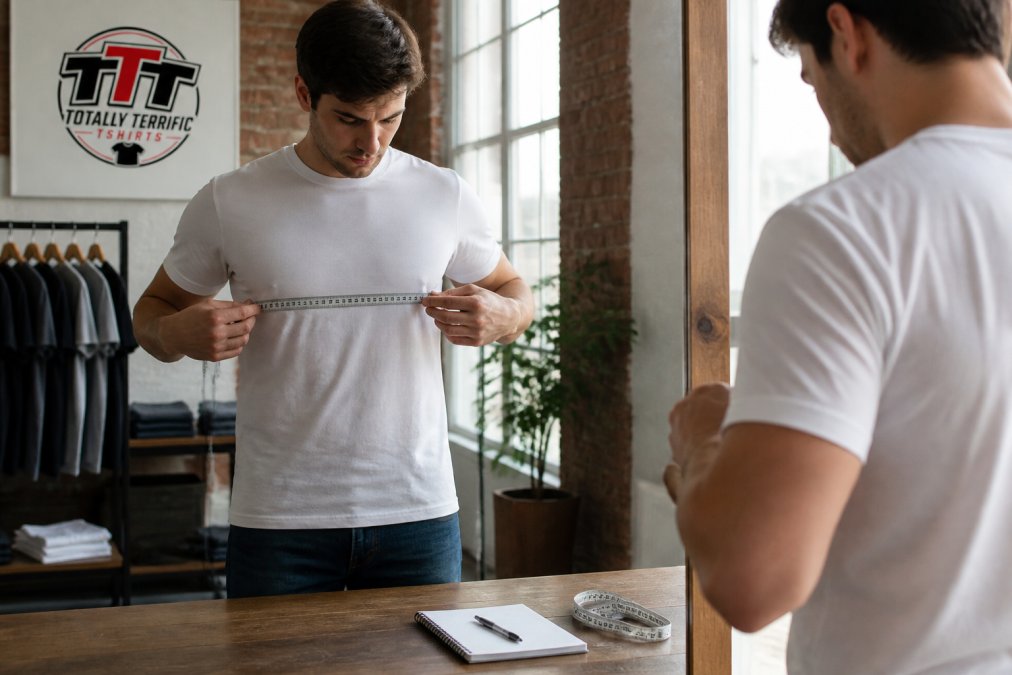
Measuring Neck Circumference
Wrap the tape around the base of your neck, right where a collar would sit. That's the spot where your neck meets your shoulders, not up high near your Adam's apple, and not down on your collarbone. Keep one finger under the tape so it's snug but not choking. Round up to the nearest half inch.
Chest and Bust Measurement
Run the tape around the fullest part of your chest, usually right across the nipples. Keep the tape level all the way around, parallel to the floor, not dipping in back. Don't pull it tight or let it sag.
Shoulder Width
Find the bony point at the edge of each shoulder, the acromion, if you want the anatomical name. Measure straight across your back from one point to the other. This one's hard to do alone, so grab that friend.
How Fit Type Changes These Numbers
Slim, regular, and relaxed cuts use the same body measurements but add different amounts of ease, the extra room between your body and the fabric.
- Slim fit: roughly 2 to 3 inches of ease at the chest. Snug through the torso, tapered at the waist.
- Regular fit: roughly 4 to 6 inches of ease. The classic straight cut most people picture.
- Relaxed fit: 6 inches or more. Drapes away from the body, roomy through the midsection.
| Measurement | Where to Measure | Why It Matters |
|---|---|---|
| Neck | Base of neck, where collar sits | Collar comfort |
| Chest | Fullest part, tape level | Overall fit profile |
| Shoulder | Bone to bone across the back | Seam placement |
| Sleeve | Shoulder to hem | Arm coverage |
| Bicep | Thickest point | Sleeve tightness |
| Wrist | Below wrist bone | Cuff fit |
Measuring Sleeve Length, Bicep, and Wrist for a Comfortable Fit
Sleeve numbers decide whether a shirt feels relaxed or restrictive. They also affect how the shirt looks on you.
Sleeve Length
For short sleeves, measure from the shoulder point down to where you want the hem to land. Most people like it about mid-bicep. For long sleeves, start at the shoulder and measure to your wrist bone.
Bicep and Wrist Measurements
Wrap the tape around the thickest part of your upper arm, relaxed. Then measure your wrist just below the wrist bone. These matter most for fitted or slim fit styles.
| Measurement | Where to Measure | Why It Matters |
|---|---|---|
| Neck | Base of neck | Collar comfort |
| Chest | Fullest part | Overall fit profile |
| Shoulder | Bone to bone | Seam placement |
| Sleeve | Shoulder to hem | Arm coverage |
| Bicep | Thickest point | Sleeve tightness |
| Wrist | Below wrist bone | Cuff fit |
Waist, Hip, and Shirt Length Measurements for T-Shirt Fit
Waist and length numbers control how a shirt drapes. They matter more than most people think.
Waist and Hip Measurement Techniques
Measure your natural waist, the narrowest part above your belly button. Then measure your hips at the widest point. Keep the tape level and breathe normally.
How to Measure Shirt Length
Lay a t-shirt you love flat on a table. Measure from the top of the shoulder seam straight down to the bottom hem. That's your vertical length target.
Your T-Shirt Size Chart Guide: Turning Measurements into the Right Size
A t-shirt size chart guide only works if you compare your numbers to the right column. Most brands list chest width, body length, and sleeve length. Some add shoulder and neck.
Here's how to read one:
- Find your chest measurement in the chart
- Check that the body length matches your target
- Compare shoulder width to your own
- If you're between sizes, size up for relaxed fit
- Size down only for slim fit styles
Custom T-Shirt Sizing Best Practices for Groups and Gifts
Custom t-shirt sizing best practices start with one rule: never assume. Ask everyone for their numbers, or at least their usual size in a brand they wear often.
A few tips that save headaches:
- Collect sizes early, not the week before the event
- Add one or two extra shirts in common sizes
- Note that unisex and women's cuts run differently
- For gifts, lean toward relaxed fit
- Double-check kids' sizes separately
Fabric Shrinkage and Body Posture: What Most Guides Miss
Two things change your fit after you buy: fabric shrinkage and posture. Neither shows up on a standard size chart. This is the section most guides skip entirely, and it's the one that decides whether your shirt still fits six months from now.
How Much Will Your Shirt Actually Shrink?
Cotton shrinks. That's not a defect, it's the fiber relaxing after the tension of weaving and dyeing is released. Here's what to expect:
- 100% cotton: commonly loses 3% to 5% in length and 2% to 4% in width after the first few hot-water washes. On a 30-inch body length, that's roughly an inch of lost length.
- Cotton/polyester blends: shrink far less, usually 1% to 2%, because the polyester fibers hold their shape. A 50/50 blend is the steadiest option for a shirt you want to keep its size.
- Tri-blends (cotton/poly/rayon): minimal shrinkage, but rayon can stretch out with wear and snap back in the wash.
- Pre-shrunk cotton: already went through the wash cycle at the factory, so expect under 2% additional shrinkage.
Why Your Posture Changes the Numbers
Standing tall with shoulders back adds width across your chest and back, sometimes a full inch compared to a slouched stance. Slouching pulls the fabric forward and makes a shirt look longer in front and shorter in back.
- Stand against a wall with your heels, hips, and shoulder blades touching.
- Step away and hold that posture, that's your true standing frame.
- Have your helper take the chest and shoulder measurements now, not while you're hunched over a phone.
Adjusting for Specific Body Types
Generic size charts assume an average build. Here's how to adjust when you're not average:
- Athletic or broad-shouldered builds: your chest and shoulder numbers may land you in a large while your waist says medium. Size to the chest and shoulder, you can always have the waist taken in, but you can't add fabric. Look for athletic or tapered cuts that narrow below the chest.
- Tall builds (over 6'1" or long-torsoed): standard tees will ride up. Look for tall sizes, which add 2 to 3 inches of body length and about an inch of sleeve length without widening the chest.
- Plus-size builds: measure the fullest point of your chest and your natural waist, then size to the larger number. Relaxed and extended-size cuts add ease through the midsection without ballooning at the shoulders.
- Petite frames: check youth sizes or women's cuts, which shorten the body and sleeve without shrinking the chest as much as a size down would.
Frequently Asked Questions
How should a perfect t-shirt fit across the shoulders?
The shoulder seam should sit right at the edge of your shoulder bone, not hanging past it or pulling inward. When you measure shoulder width, go from one shoulder point to the other across your back. If the seam droops, the shirt is too big. If it digs in, size up. A proper shoulder fit keeps the whole shirt hanging correctly.
Does fabric type affect how I should measure for a t-shirt?
Yes. Cotton shrinks about 3-5% after the first few washes, so add a little room if you are between sizes. Blended fabrics like cotton-polyester hold their shape better and shrink less. If you are ordering custom t-shirts, ask about the fabric content and whether it is pre-shrunk. This helps you avoid a shirt that fits perfectly on day one but feels tight after a week.
How can I ensure my custom apparel fits perfectly before ordering?
Measure a t-shirt you already own and love, lay it flat, and compare those garment dimensions to the size chart. Check chest width, shirt length, and sleeve length. If you are ordering for a group, collect everyone's measurements using a t-shirt size chart guide. When in doubt, size up for a relaxed fit. Totally Terrific Tshirts offers a range of designs for nurses, teachers, and faith communities.
Should a t-shirt be tight or loose around the midsection?
A well-fitting t-shirt should skim your midsection without clinging or ballooning. You want about 2-3 inches of ease beyond your actual waist measurement for a comfortable fit. If the fabric pulls across your stomach when you raise your arms, it is too tight. If it billows out, it is too loose. A relaxed fit works for most casual wear, while a slim fit hugs closer to the body.