

Table of Contents
- Why Small-Batch Custom Shirts Are Finally Affordable
- Direct to Garment Printing vs Screen Printing for Single Units
- How to Design Custom Shirts for Small Groups
- Turnaround Time for Custom Apparel: What to Expect
- Cost-Per-Unit Breakdown for Small Orders
- DIY vs. Professional Outsourcing: Which Saves You Money?
- Common Mistakes to Avoid When Ordering Small-Batch Custom Shirts
- Frequently Asked Questions
Last Updated: September 29, 2026
Why Small-Batch Custom Shirts Are Finally Affordable
Ordering custom shirts without bulk requirements used to mean paying a premium for a single unit. Digital printing and print-on-demand have changed that, making small runs practical for friend groups, nursing teams, and family reunions.
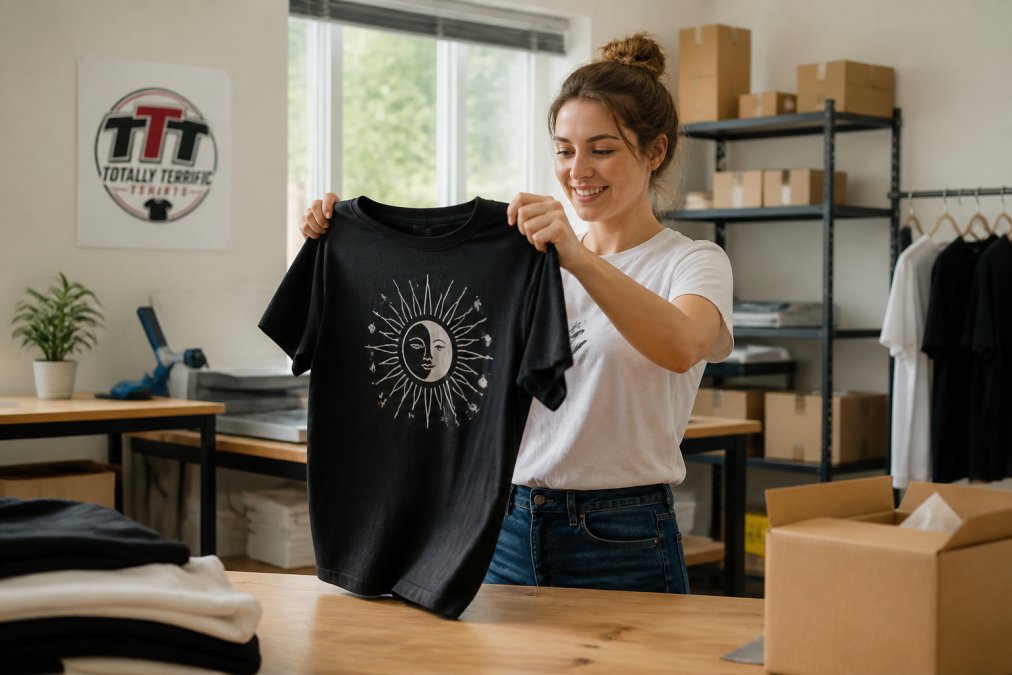
Direct to Garment Printing vs Screen Printing for Single Units
Direct to garment printing is a digital method that prints your design straight onto the fabric, like a giant inkjet printer for shirts. No screens, no setup, which is why single units are possible.
When DTG Makes Sense for One-Off Designs
DTG is the clear pick for small batches. Consider it when:
- You need 1 to 11 shirts
- Your design has lots of colors or shading
- You want to test a design before committing
- You're ordering for a small friend group or team
Why Screen Printing Still Wins for 12+ Shirts
Once you cross roughly a dozen shirts, screen printing usually costs less per unit, and it wins on durability for bold, simple designs. Fewer colors, longer life.
How to Design Custom Shirts for Small Groups
Good small-batch design starts with restraint, simple, bold designs print better and cost less. Here's a workflow that works:
- Pick your concept and message
- Choose 1 to 3 ink colors
- Create your file in vector format (SVG, AI, or EPS)
- Size your design to the print area
- Request a digital proof before printing
Choosing the Right Blank for Comfort and Print Quality
The shirt matters as much as the design. A soft, ring-spun cotton blank takes ink well and feels good against skin, while heavier cotton holds up longer than lighter blends that can pill faster.
Look for these features on any blank you consider:
- Double-needle collar for a smoother print surface
- Tear-away label if you plan to rebrand
- Tubular fit to reduce twisting after washing
- A range of colors that matches your design
Turnaround Time for Custom Apparel: What to Expect
Turnaround time for custom apparel usually runs 3 to 10 business days for small orders, but that range only makes sense once you know what happens inside it. A single custom shirt moves through a pipeline, and each stage adds time.
Here's the typical sequence for a small order:
- Order review and file check, someone confirms your artwork is print-ready (same day to 1 business day)
- Proof approval, you sign off on a digital mockup (adds a day if you're slow to reply)
- Production, the shirt is printed and cured (1 to 5 business days depending on method)
- Quality check and packing, print inspected, folded, bagged (same day to 1 business day)
- Transit, carrier time to your door (2 to 5 business days for standard ground)
Production Time vs. Transit Time: Two Different Clocks
The most common planning mistake is treating production and shipping as one number. They're separate clocks that run back to back:
- Production time is how long the shop needs to make your shirts
- Transit time is how long the carrier needs to deliver them
Rush Orders: What's Realistic and What Isn't
Rush production is real, and most shops offer it for an added fee, but it can't compress physics. A rush order typically shaves production to 1 to 3 business days, though it rarely speeds up transit unless you pay for expedited shipping on top.
Rush works best when:
- Your artwork is already print-ready (no file fixes needed)
- You approve the proof within hours, not days
- You're flexible on the exact blank or color if stock is tight
How to Plan Backward from Your Event Date
Here's a simple backward-planning method for any small order:
- Write down your event date
- Subtract 3 days as a safety buffer
- Subtract transit time (assume 4 days for standard ground)
- Subtract production time (assume 5 days for a small run)
- The result is your latest safe order date
For a Saturday event, that usually puts your order date about two weeks out. If you're inside that window, ask about rush before assuming it's impossible.
Seasonal Slowdowns to Know About
Whether you're ordering matching shirts for a nursing crew, a teachers' team, a retired group, or a patriotic family reunion, knowing the timeline keeps the fun in the process. Our blanks are built for DTG printing, so single units and small runs move through production quickly. Browse the full lineup at totallyterrifictshirts.com and pick your design with time to spare.
Cost-Per-Unit Breakdown for Small Orders
Single-unit orders cost more per shirt than bulk orders, simple math, not a scam. Here's the honest breakdown of where your money goes on a small run:
| Cost Factor | What It Covers | How It Changes with Volume |
|---|---|---|
| Blank garment | The shirt itself | Roughly flat per unit; slight discounts at higher quantities |
| Printing | Ink, labor, machine time | Higher per unit at low volume because setup is spread across fewer shirts |
| Setup or file prep | Screens or digital file work | Only applies to screen printing; disappears with DTG |
| Shipping | Delivery to you | Flat per order, so it costs more per shirt on a 1-shirt order |
| Packaging and handling | Bagging, folding, labels | Small but real; spread across the order |
Why One Shirt Costs More Than One-Fiftieth of Fifty Shirts
Think of it like a taxi ride: the meter starts the moment the driver turns the key, whether you're going one block or ten. Custom printing works the same way, a single custom shirt often costs several times what a bulk per-unit price suggests, not as a markup for inconvenience, but as the fixed cost of making one thing well.
Where DTG Changes the Math
Direct to garment printing removes the biggest fixed cost: screen setup. No screens means no setup fee, the single largest reason small orders used to be impractical. With DTG, a 1-shirt order still costs more per unit than a 50-shirt order, but the gap is far smaller, you're paying for ink, machine time, and handling, not screens used once.
How to Think About Value, Not Just Price
- Print durability, a well-cured DTG print outlasts a cheap heat transfer
- Blank quality, a soft ring-spun cotton blank feels better and prints cleaner
- Consistency, every shirt in a small run should match
- Time saved, outsourcing beats DIY unless you're printing regularly
Whether you're ordering one funny tee for yourself or matching shirts for a Christian retreat, a patriotic parade, or a country music fan club, no-minimum ordering means you never pay for shirts you don't need. Explore the full collection at totallyterrifictshirts.com and order exactly what you want.
DIY vs. Professional Outsourcing: Which Saves You Money?
DIY printing saves money only if you already own the equipment, a heat press, transfer paper, and decent blanks add up fast.
- DIY wins if: you're printing 20+ shirts over time and enjoy the process
- Outsourcing wins if: you want one order done right, once
- DIY risks: uneven pressure, peeling transfers, wasted blanks
- Outsourcing wins on: consistency, print quality, and time saved
Common Mistakes to Avoid When Ordering Small-Batch Custom Shirts
The biggest mistake is submitting a low-resolution file, it prints blurry, and there's no fix after the fact. Watch for these too:
- Forgetting to check the size chart before ordering
- Choosing a design with too many colors for screen printing
- Skipping the digital proof
- Ordering without confirming the ship date
- Assuming all cotton blends print the same
Frequently Asked Questions
How many shirts are considered a bulk order?
Most suppliers consider 12 or more shirts a bulk order, but that threshold varies. With direct-to-garment printing, you can order as few as one custom shirt without paying setup fees. Screen printing typically becomes cost-effective at 12 to 24 units because the screens are reused across the run. If you only need five shirts for a friend group or a small team, DTG is usually the better fit.
What printing methods are best for single custom shirt orders?
Direct-to-garment printing is the go-to for single units because it requires no screens and no minimums. Heat transfer and sublimation also work for one-offs, though sublimation only bonds to polyester. For a soft, retail-quality feel on cotton, DTG wins. If you plan to reorder the same design repeatedly, screen printing can save money at higher volumes, but for one shirt, DTG keeps costs and lead times low.
Are there hidden costs when ordering custom apparel in small quantities?
Watch for setup fees, screen charges, and per-color fees that bulk pricing usually absorbs. Some shops also add small-order surcharges or require you to buy a minimum number of units. Direct-to-garment printing avoids most of these because there is no screen setup. Always confirm the total price includes the blank, the print, and shipping before you check out. Free shipping thresholds, like orders over $75, can also change your final cost.
How can I ensure quality when ordering custom shirts without minimums?
Check the fabric weight and material before ordering. A 100% ring-spun cotton shirt with a double-needle collar holds up better wash after wash than a thin, generic blank. Ask about the print method and request a sample if you can. Read the care instructions, since tumble drying low or hanging to dry preserves the print.